

Axioma database
The most convenient and efficient solution for pharmaceutical companies provides access to a comprehensive database of physicians, healthcare providers, and pharmacies so you can focus on accurate and effective promotion of your drugs.
Learn More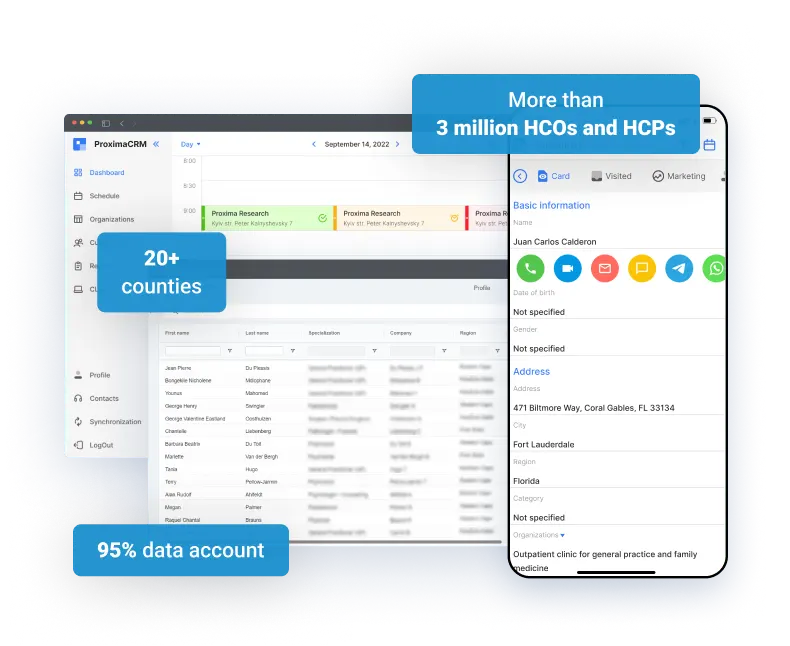














Key Benefits
A new dimension of data management and medical business development
Key Benefits
A new dimension of data management and medical business development

Local data protection and ISO certification
- Axioma fully complies with local laws on the processing of personal data and is ISO 27001 and ISO 27701 certified. Your data is protected at the highest level of security.

Data relevance
- Thanks to a large number of data sources, data is validated daily, ensuring high accuracy and relevance.

Integration with CRM systems
- Axioma provides continuous data exchange with your CRM system. This allows you always to have up-to-date information for your strategic decisions.

Categorization for effective planning
- Our tools allow you to categorize physicians for strategic planning of visit activity. You'll be able to allocate resources and efforts accurately to maximize results.

Analysis and strategic planning
- With our data, you can identify uncovered areas and potential for future growth.

Effective communication
- Use personal contact information - cell phone numbers and email addresses - to communicate remotely with medical professionals. Reach a larger audience and improve communication effectiveness.

Verify and filter client data
- Our unique service for verifying client phone numbers and email addresses lets you focus only on current and relevant data. You effectively “weed out” irrelevant records, ensuring accuracy and reliability in your planning.

Technical User Support
- With our technical support, client requests are handled within 1 business day.
Axioma Syndicated Database
Axioma is an innovative tool for medical business management. A syndicated database that turns the perception of efficiency in the healthcare industry upside down. Axioma benefits include accurate and up-to-date information, system categorization for strategic planning, analysis and strategic planning, validation and filtering of customer data, maximizing communication with medical professionals, and CRM compatibility. Privacy protection and ISO certification ensure security. Users achieve convenience, marketing efficiency and information reliability, directing efforts to key tasks and gaining increased sales. Axioma is the key to success in the medical field.




Pharma's own database:
Average data relevance
60-70%

Database of other providers:
The average relevance of the data
70-80%

Axioma database:
Data relevance
95%
Using
Axioma companies get
We understand the importance of accurate and up-to-date data to make business decisions. Our validation process is built to maximize the reliability and consistency of your data:
Learn more
Data Quality Analysis
We perform a detailed analysis of your information to identify inaccuracies and missing or outdated records. This allows us to identify and resolve any issues quickly.

Proactive data collection
We regularly update data through telephone surveys, web resources and other channels to ensure it is up to date.

Record Optimization
All data is checked for duplicates to avoid confusion and ensure data is unique.

Correcting and updating information
We verify that addresses, contact information, and other key elements are correct and update them regularly to keep them up to date.

Always maintaining accuracy
Proactive daily updates ensure your information remains current and accurate in the face of rapid change.

DCR processing
Data management experts review data change requests from all service users on a daily basis (95% of data change requests are resolved within 1 business day), allowing you to respond to any changes as quickly as possible.

A combination of automation and manual checking
Our processes combine the efficiency of automated systems with specialist work to ensure high-quality data.
This process ensures that your data always meets the highest quality standards, helping you make the right decisions and manage your business effectively
Axioma Privacy Policy
Axioma is a central master data database of validated, regularly updated information on healthcare professionals and healthcare organizations, powering pharma CRM workflows and analytics. The Privacy Policy is available via the link.
Explore more


-
 Market Audit
 Axioma
 Pharmacy Stock
 Proxima Cloud CRM
 Proxima OCM
 GeoForce
 Photo Recognition
 BI+Distributors Reports
-
 Proxima CLM
 Proxima Apteka
 DB Drugs
 PromoTest
 Proxima CRM
 RXTest


The medical business is developing rapidly, and executives increasingly face the need to make decisions based on reliable information. Mistakes in visit planning, interaction with physicians, or cooperation with pharmacy chains can lead to a loss of competitive advantages. To avoid this, companies rely on digital solutions for clinics and medical information systems. Among them, the Axioma database occupies a special place — as a system that combines management tasks, marketing, and strategic development.
Effective Management of Medical Business
Key challenges for owners and managers
The success of a healthcare company largely depends on proper medical accounting. Leaders need to see the full picture: from financial indicators and staff efficiency to the quality of interactions with patients and partners. Errors or fragmented data in these processes result in wasted time and resources.
To avoid risks, companies are increasingly adopting medical business automation tools. They help to optimize processes and focus on growth:
-
-
- Reduce paperwork and mistakes from manual processing.
- Provide quick access to staff and departmental performance indicators.
- Generate transparent reports for executives at all levels.
- Enable convenient real-time control of costs and revenues.
-
Special attention is given to medical information systems that integrate fragmented data into a unified medical database. Thanks to this, management receives a holistic view of the organization’s activities: specialist workload, patient statistics, and the effectiveness of marketing campaigns.
The role of digital solutions in modern management
Effective healthcare management is impossible without tools based on analytics. Modern technologies allow executives to:
-
- Plan the visit activity of field staff.
- Evaluate the actual workload of physicians.
- Forecast the needs of patients and pharmacy chains.
- Make decisions based on facts, not assumptions.
- Plan the visit activity of field staff.
More and more managers are implementing specialized medical center programs. These include modules for scheduling, client system management, visit control, and automatic report generation. This approach simplifies staff work and increases transparency for management.
Syndicated Database: A Source of Objective Analytics
What is a syndicated database and how does it work
Axioma pharmaceutical database is a syndicated database that consolidates information about doctors, pharmacies, and healthcare institutions. Unlike scattered local lists, it is built from multiple sources, regularly validated, and provides companies with a complete market picture.
The information includes:
-
- Profiles of more than 340,000 physicians and pharmacists worldwide.
- Data on over 250,000 pharmacies worldwide.
- Verified contacts for remote communication (phones, emails).
- Details on specialties, workplaces, and positions.
- Profiles of more than 340,000 physicians and pharmacists worldwide.
Such a structure makes the aggregated medical database convenient for both daily work and strategic tasks.
Advantages of using it in the pharmaceutical industry
For pharma companies, it is crucial to have not only contact details but also complete analytics. That is why Axioma is positioned as a medical data platform that integrates with CRM and corporate web resources.
Key benefits:
-
- Unified format of information for sales, marketing, and analytics departments.
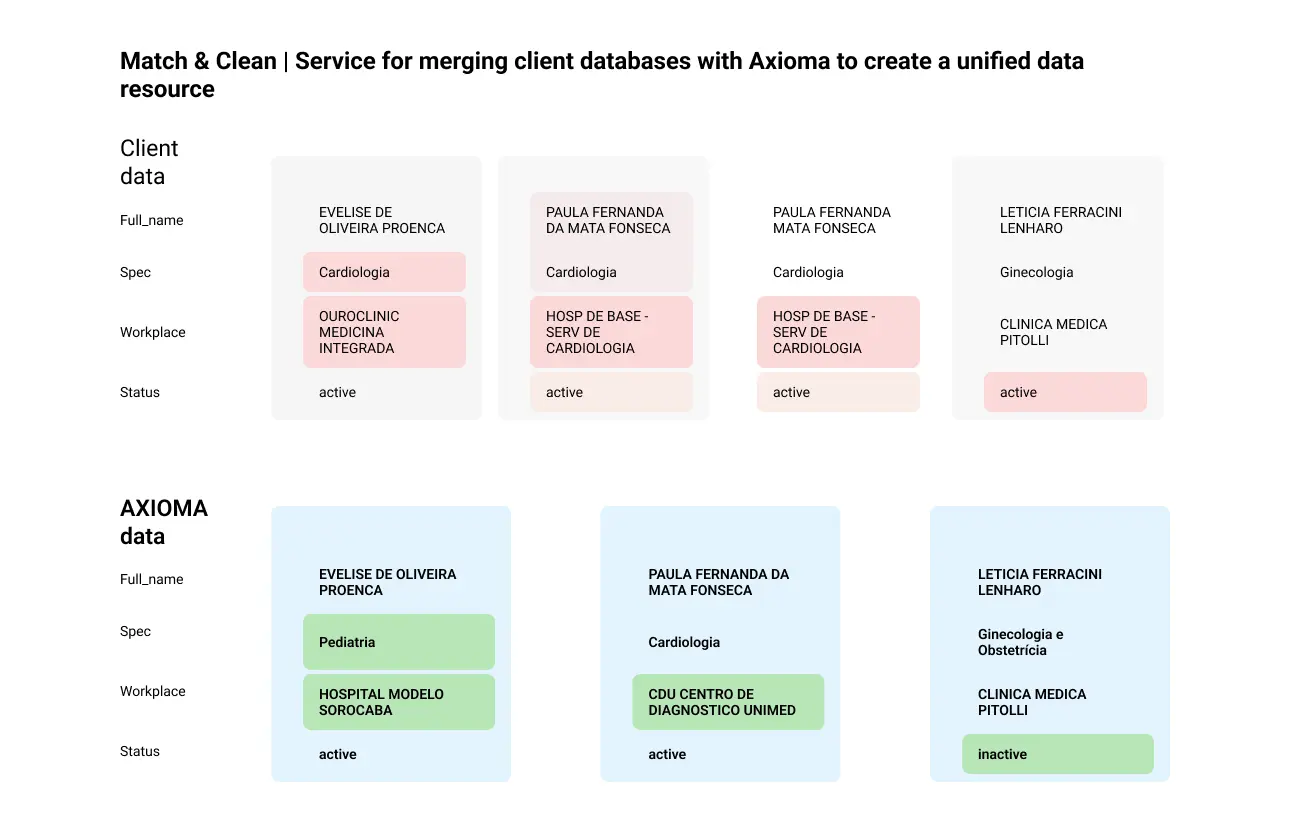
- Elimination of duplicates through automated cleaning (Match & Clean).
- Transparency in allocating visit activity of medical representatives.
- Regular updates on visit pressure and patient flows.
- Extended categorization by nosologies.
- Unified format of information for sales, marketing, and analytics departments.
In essence, it is a centralized database that solves the core need of pharma companies — working only with accurate, verified, and up-to-date data.
Axioma Database — A Modern Tool for Analytics
Axioma capabilities and functionality
The Axioma system for hospitals is designed for structured information management about doctors, pharmacies, and healthcare institutions. It contains personal data, workplaces, contact details, and specialization categories.
What companies receive:
-
- 95% data relevance through daily validation.
- Match & Clean service for seamless transition from other providers.
- Categorization of physicians by patient flow and visit activity (A, B, C).
- Compliance with ISO 27001 and ISO 27701 security standards.
- 95% data relevance through daily validation.
The Axioma medical database is especially valuable for the pharmaceutical market as it allows planning field force activity and assessing territorial potential.
How the database helps to make business decisions
Managers gain access to analytics that help to:
-
- Identify physicians with high patient flow and schedule visit frequency.
- Calculate visit pressure for optimal resource allocation.
- Segment specialists by nosologies for targeted promotion.
- Control changes through the DCR service (95% of requests processed within one business day).
- Identify physicians with high patient flow and schedule visit frequency.
Thus, the Axioma CRM-compatible database is reliable for strategic planning and precise medical business optimization.
Integration with CRM: Space for Automation
Why combine a database with CRM
In medical business management, client data must be updated quickly and accurately. A CRM-enabled database provides exactly that — synchronizing with corporate systems and ensuring real-time relevance.
Integration with CRM solves critical tasks:
-
- Automatic updates of physician, pharmacy, and institution contacts.
- A unified data storage for all departments — from marketing to sales.
- Elimination of duplicates and accounting errors.
- Automatic updates of physician, pharmacy, and institution contacts.
Advantages for the sales and marketing department
For sales teams, a client accounting database simplifies visit planning, tracks interaction history, and monitors task completion. This avoids duplicate efforts and increases team transparency.
For marketing, the CRM-integrated database supports broader automation: segmentation of target HCP groups, personalized campaigns, and evaluation of promotional activities. This enables quick strategic adjustments and faster market response.
CRM integration creates a customer interaction automation database where departments work in sync, directly boosting business efficiency.
Pharmaceutical Database as a Strategic Resource
Drug market analytics
A modern information database about medicines is not just a list of products but a tool for drug market analytics and demand forecasting. It helps companies to:
-
- Track stock levels and drug movements in pharmacy networks.
- Evaluate market share by therapeutic groups.
- Monitor demand shifts at regional and national levels.
- Support marketing strategies and promotional activities.
- Track stock levels and drug movements in pharmacy networks.
Using data to expand market presence
An electronic medicines database with structured details on trade names, dosage forms, and manufacturers is indispensable for analysts who build long-term forecasts and plan new launches.
Additionally, companies use a pharmaceutical guide to assess competition and explore opportunities for expansion. This tool allows quick access to medicines, comparison of characteristics, and development of promotion strategies.
A pharmaceutical database thus becomes a foundation for strategic planning and helps strengthen brand positions in key market segments.