Review of global trends in pharma business. Part II – Ukraine and Central Asia
06.03.2026
In the first part, we reviewed global trends in the pharmaceutical market and the development of the pharma industry in the USA and Europe.
In this article, we analyse the prospects of the Ukrainian pharmaceutical market and the markets of Central Asia.
The Ukrainian pharma market — a promising part of the European and global market. The scale of Ukraine’s pharma market, its structure and growth prospects
Let us consider the main trends in the pharmaceutical market of Ukraine in figures, based on materials from the analytical company Proxima Research.
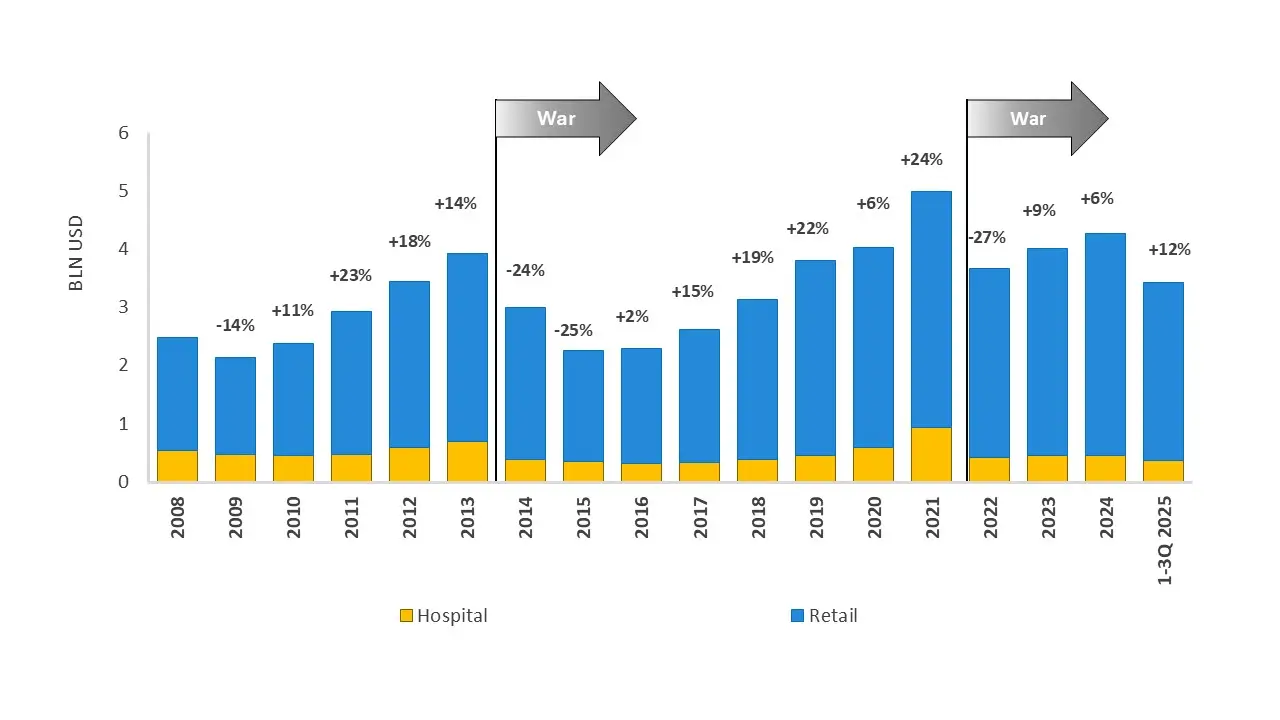
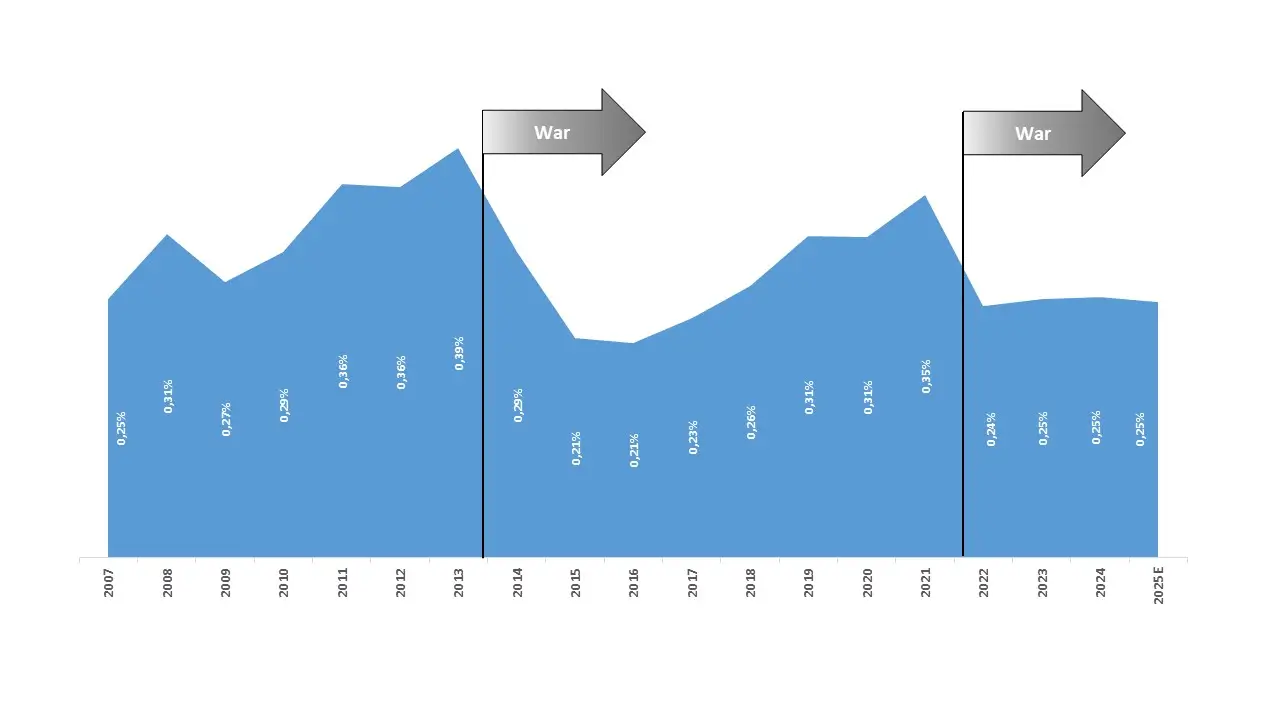
Despite the war, the medicines market in Ukraine remains large and resilient. The retail and hospital segments together account for more than USD 4 billion in 2023–2025 (Fig. 8) and have a share in global medicines consumption of 0.25% (Fig. 9). Ukraine’s pharma market has significant growth potential, which will unfold as the economy recovers and Ukrainians’ incomes rise. The dynamics of Ukraine’s share in global medicines consumption reflects the intention to grow and develop. Only the war holds it back.
Fig. 8.Dynamics of retail and hospital consumption of medicines in Ukraine for 2008–Q1–Q3 2025, with % growth indicated, USD billion, %
Fig. 9.Dynamics of the share of the Ukrainian pharma market in the global volume of medicine consumption for 2007–2025, %
Medicines consumption is almost inelastic—people need them at all times. The dynamics of the Ukrainian pharma market show that even under the strongest shocks caused by Russia’s military aggression in Ukraine, the market strives to recover and grow.
The lion’s share of consumption falls on the retail segment—80–90% in value terms—so most medicine spending is borne by patients. At the same time, the state continues the reimbursement programme and other initiatives to support patients.
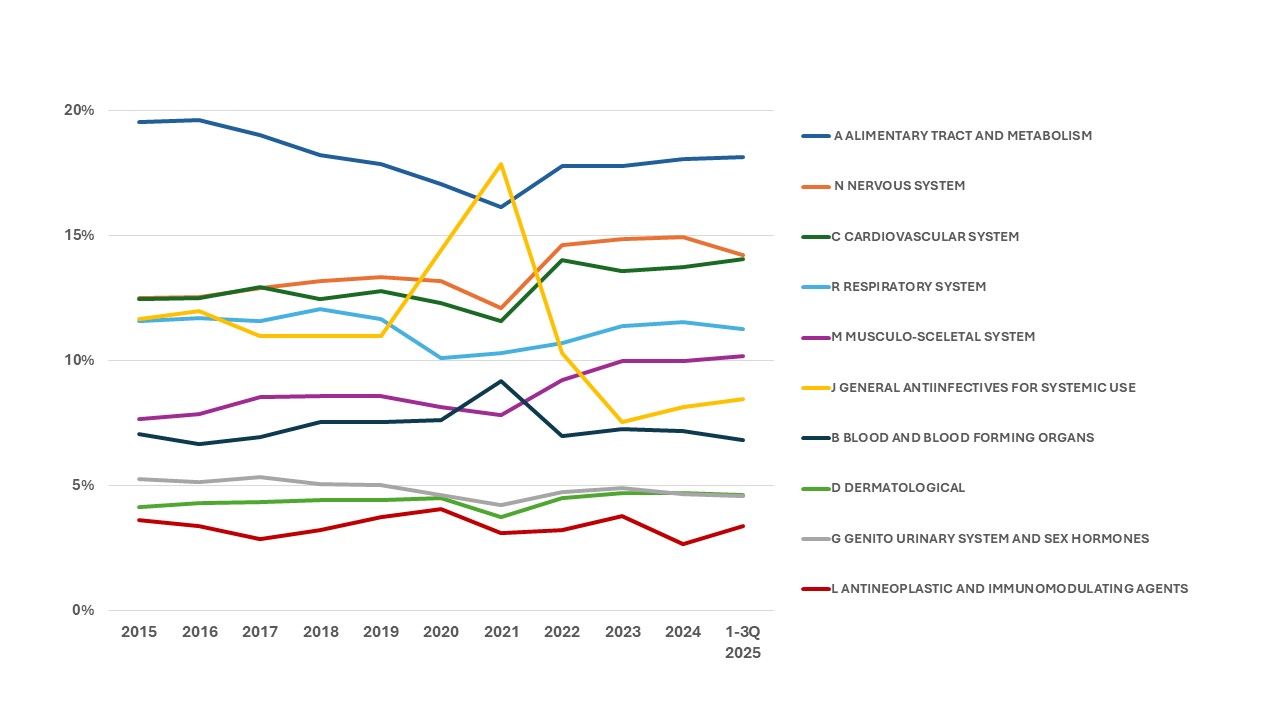
In the therapeutic breakdown (according to the ATC classification, level I), the top five are medicines that affect the digestive system and metabolism, the nervous system, the cardiovascular system, the respiratory system, and the musculoskeletal system (Fig. 10). Since the start of Russia’s full-scale invasion of Ukraine in 2022, an increase has been recorded in the share of diseases of the nervous and cardiovascular systems and the musculoskeletal system.
Fig. 10.Dynamics of the structure, in USD value, of hospital and retail medicines consumption in Ukraine, by the top-10 therapeutic areas, for 2015–Q1–Q3 2025, %
Thus, the market demonstrates high resilience and fast adaptability. With stabilisation, the market can become one of the most dynamic in Eastern Europe.
Key trends of the pharmaceutical market in Ukraine
The realities of running a pharmaceutical business in Ukraine during the war differ significantly from the opportunities available to companies in most other countries. Russia’s military aggression in Ukraine causes a whole range of problems that businesses are forced to address: strikes on infrastructure and power outages, logistical restrictions and higher delivery costs, dependence on imported raw materials, exchange-rate fluctuations and inflation, staffing risks (migration of specialists), regulatory changes, limited access to medicines for patients in frontline settlements, and more. Let us consider the factors that help the industry survive, develop and become more adaptive and resilient even under war and economic pressure.
Adaptation of manufacturing and logistics
Ukrainian pharma companies, within their capabilities, address the following tasks:
relocation of production facilities to safer territories;
diversification of warehousing for materials and finished products;
increasing stocks of raw materials;
implementation of continuous production mode (ensuring energy reserves and backup capacity, duplicating suppliers).
Some enterprises have signed contracts for manufacturing and storing products outside Ukraine (Poland, Lithuania, etc.). This reduces risks and supports exports.
Digitalisation, smart technologies, AI
Many companies are implementing digital management systems—for example, automated ERP (Enterprise Resource Planning) platforms, cloud data storage, electronic document workflow and analytics—which improves planning, production and quality-control processes.
Robotic solutions and modern logistics systems (for example, automated warehouses) are being used, increasing efficiency and production resilience.
Pharmaceutical companies are introducing AI technologies into scientific and business processes, which can speed up data analysis, optimise production and increase forecast accuracy.
European integration
Ukrainian pharma is taking systematic steps towards European integration—from reforming legislation and improving product quality to creating an effective regulator and participating in European initiatives.
The strategic goal is free access to the EU market without additional barriers, which will ensure increased exports, improved quality and an inflow of investment.
Ukrainian companies participate in European associations such as Medicines for Europe, which strengthens strategic ties, access to knowledge and the ability to influence standards.
Quality standards and international exports
Most leading Ukrainian manufacturers already meet GMP requirements and obtain European certificates, making their products competitive. The main barrier is that GMP certificates issued in Ukraine are not yet recognised at the EU level. This means companies have to undergo additional checks and inspections when exporting, increasing costs and time to market.
Achieving mutual recognition of GMP certificates and including medicines in conformity-assessment agreements will be a key step towards free access of Ukrainian medicines to the EU market.
R&D and innovations
Major companies are actively investing in the R&D of new medicines. For example, Farmak invested UAH 757 million in R&D in 2024, which made it possible to launch up to 20 new products each year to treat various diseases (antibiotics, surgery products, medicines for cardiovascular conditions, etc.). Moreover, the company obtained marketing authorisations for new medicines in the EU and China, indicating that Ukrainian innovations are entering the international market.
According to Ukraine’s Digital Transformation Strategy in the field of innovation until 2030, the development of biotechnology and medical technologies (MedTech) opens significant opportunities for investors—especially in gene therapy, personalised medicine, medical devices and digital health solutions.
Price pressure and reform of medicine pricing
In 2025, the state introduced broad regulation of the pharmaceutical market aimed at increasing pricing transparency, limiting unjustified mark-ups, reducing patients’ overpayments, linking prices to European benchmarks, and strengthening control over the sale of medicines. However, experts note that the effect of these measures is still mixed: a full reduction of end prices has not yet been achieved, and there are risks for the supply and availability of certain products.
Key takeaways on trends in Ukraine’s pharma business
Ukrainian pharma demonstrates high resilience and the ability to rapidly adapt. Even under difficult conditions, it manages to maintain production and provide the country with the medicines it needs. It is worth noting that Ukraine’s pharma industry is progressing in digital transformation and standardisation and strengthening integration with the EU.
Despite the war, investments in the development of generics and biosimilars are increasing; contract manufacturing of medicines is developing; IT solutions and digital medicine are improving; pharmaceutical analytics and pharmacovigilance are advancing. There are strong R&D schools, clinical bases and human capital.
Per-capita medicines consumption in Ukraine is significantly lower than in the EU and Eastern Europe, and the country’s pharma market has substantial growth potential.
We have reviewed how pharma business is developing in the largest markets—the USA (with a share of over 40% of total medicines sales) and the European market (about one quarter of the global market). For comparison, let us examine key development trends of the pharma industry in a small but promising market: Central Asia (its share of total global medicines sales is up to 1%).
Review of key trends in pharmaceutical business in Central Asia
We have considered how pharma business is developing in the largest markets—the USA, with a share of more than 40% of total medicines sales, and the European market, which accounts for about one quarter of the global market.
The leaders in Central Asia are the pharma markets of Kazakhstan and Uzbekistan; the smaller markets of neighbouring countries (Kyrgyzstan, Tajikistan and Turkmenistan) are significantly smaller in scale. Let us take a closer look at trends in the markets of the region’s leaders by medicines sales in Central Asia.
Development of the pharmaceutical markets of Kazakhstan and Uzbekistan
According to estimates by the analytical company Proxima Research, Kazakhstan reached medicines consumption through the retail and hospital segments of about USD 2.5 billion in 2024. Growth was 15% compared with the previous year. Uzbekistan showed a 9% increase in retail medicines consumption to USD 1.9 billion.
Analytical data indicate that the markets of Kazakhstan and Uzbekistan show steady growth in value terms, attracting international attention and investment.
Reasons for growth:
✔ growth in population and demand for medicines;
✔ increase in the average income level;
✔ regulatory reforms and simplified registration of medicines.
Import dependence and strategic efforts towards localisation
In most countries of the region, the pharma market is heavily dependent on imports. In both Kazakhstan and Uzbekistan, imports account for about 85–87% of the market, although local production is increasing.
Governments seek to develop local production, reduce dependence on imports and attract foreign investors. Uzbekistan has created the Tashkent Pharma Park and plans to bring production localisation to 80% by 2027.
Regulatory reforms and harmonisation of standards
To develop the industry and attract investment, the countries of the region carry out reforms:
Kazakhstan and Uzbekistan are introducing mandatory certification to GMP standards for manufacturers, which raises quality and opens the way to exports;
procedures for registering medicines are being simplified, especially for products recognised by international regulators, which speeds up access to modern innovative medicines;
international platforms are opened for exchanging experience and discussing standards (e.g., pharmaceutical summits).
International investment and partnerships
Foreign investment is being attracted to the region’s pharmaceutical industry: into the construction of new plants, modernisation of production and technology transfer. Active cooperation continues with companies from Russia, China, India and the EU, which helps implement modern technologies and develop the manufacturing base.
Demand and consumption structure of medicines
In some countries (for example, Uzbekistan and Kazakhstan), an increase in the weighted-average price of one pack of a medicine is observed, reflecting growing demand for more complex and modern products. At the same time, strong consumer interest in affordable over-the-counter (OTC) products and natural/traditional remedies is seen across Central Asia. This is linked to a rise in chronic diseases and interest in alternative ways of maintaining health.
Features of other markets in the region
Kyrgyzstan: the market is opening to new partnerships, but about 90% of medicines are imported; interest is growing in international quality standards and digital control systems.
Tajikistan: strengthening of generics production and formation of the foundations of local business; the market is relatively small but stable.
Turkmenistan: significant dependence on imports; significant potential for infrastructure and manufacturing investment.
Key takeaways on trends in Central Asia’s pharma business
Central Asia is a fast-growing region with relatively low competition compared with developed markets. There is a policy of stimulating local production and technology transfer. Demand for innovative and modern medicines is rising. High import dependence and relatively weak infrastructure today are factors that constrain the industry’s development.
Key takeaways on global trends in pharma business
Thus, pharma plays an important role in ensuring public health through the development, production and distribution of medicines, and it is also a powerful driver of the global economy thanks to large investments in innovation.
Key global pharma trends include rapid development of biotechnology; digital transformation using AI and big data; a shift to personalised medicine; and rising demand for effective medicines for oncology, endocrine and orphan diseases—leading to increased consumption and investment in R&D.
Growth in developed countries is accelerating thanks to new products and wider use of existing originator medicines.
The average annual growth rate (CAGR) of the global pharma market in 2025–2029 is forecast at 5–8%.
Continued significant advances are expected, especially in oncology, immunology, diabetes and obesity. Major innovations in small molecules for these conditions are also likely, as well as in neurology.
The USA and Europe shape the global pharma agenda with an emphasis on personalised medicine, gene and cell therapy, innovations in oncology and other diseases, the spread of telemedicine, remote studies and other technological solutions.
Proxima Research is an international provider of data, technologies and services for healthcare. For more than 30 years, the company has been developing analytical solutions for the pharmaceutical business and helping decision-making based on up-to-date market information.
To receive detailed information about our popular products—Market Audit, Promo Test and Rx Test—please use the feedback form.
06.03.2026
Does the material align with your company's goals?
If the topic caught your interest — feel free to leave a request. Let's discuss how it can work for you.
Thank you!
Thank you for your request! We will contact you shortly.
Close
By clicking the "Submit Request" button, you consent to the processing of your personal data and to receiving electronic communications about Proxima Research products and services. You also agree to our Terms of Use. Your data will be processed in accordance with our Privacy Policy. You may unsubscribe at any time.
By clicking the "Subscribe" button, you consent to the processing of personal data and the receipt of electronic messages about Proxima Research products and services, and you agree to our Terms of Use. Your data will be processed in accordance with our Privacy Policy. You can unsubscribe at any time.
Thank you!
Thank you for your request! We will contact you shortly.